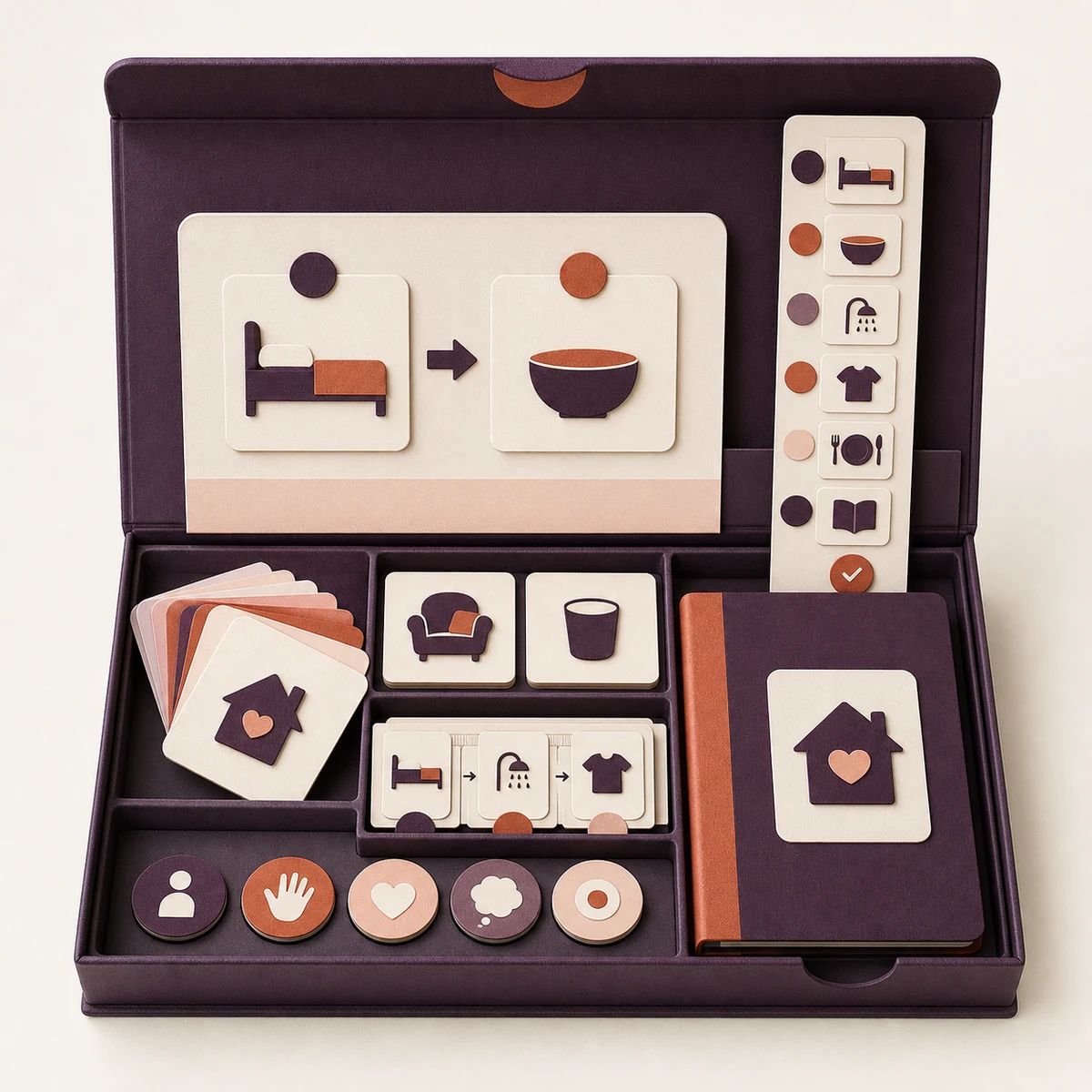
Visual supports are often described as tools for children who struggle with spoken instructions. That is true, but it is only part of the story. In residential childcare, a good visual support also reduces ambiguity between adults, makes expectations easier to revisit and gives a young person something stable to return to when emotions are high.
In brief
The strongest visual support is not the most elaborate one. It is the one that is easy to understand, used consistently and adapted with the young person rather than imposed on them.
Why spoken explanations are not always enough
Residential care is full of moments that require a young person to process information quickly: getting ready for school, changing activities, attending an appointment, completing a household task or preparing for contact. Even a clear verbal explanation can disappear when a young person is anxious, tired, distracted or unsure whether different adults mean the same thing.
A visual prompt remains available after the conversation has ended. It can show the order of events, reduce the amount of language being held in working memory and make a request feel less personal. Instead of an adult repeating, “I have already told you,” both people can look at the same plan and work out what needs to happen next.
Visual structure is not the same as control
A visual timetable can become unhelpful if it is used only to direct behaviour. Good practice leaves room for choice, negotiation and change. The purpose is to make the day easier to understand—not to remove a young person’s voice.
- Use familiar images, objects or symbols that make sense to the individual.
- Offer genuine choices where choices are available.
- Show changes visibly instead of quietly altering the plan.
- Build in breaks, preferred activities and time to regulate.
- Remove finished steps so progress is easy to see.
Language matters too. “This is what we agreed” feels different from “This is what you have to do.” A visual tool should support the relationship, not stand in for it.
Start with one repeated pressure point
Teams sometimes introduce a complete visual system in one go. That can create more work than clarity. Begin with a predictable point of friction: the morning routine, the transition from gaming to dinner, the sequence before leaving the house or the steps needed to prepare for family contact.
Choose the smallest useful format. A two-step board may be enough. A short sequence may work better than a whole-day timetable. If the young person already understands the routine but struggles with time, transition cards may be more useful than activity symbols.
Consistency across adults matters
The same support can feel reassuring with one adult and controlling with another. Agree how the team will introduce it, what language will be used and what flexibility is built in. Record what has been helpful in the care plan or communication guidance so new and agency staff do not have to guess.
A useful team check is to ask:
- What is this support helping the young person to understand?
- How will the young person show that it needs changing?
- Which parts are fixed, and which parts are negotiable?
- What will adults do if the plan cannot happen?
Review the tool with the young person
Do not measure success only by compliance. Look for reduced repetition, quicker recovery after a change, more independent checking of the plan and greater confidence in asking what comes next. Ask the young person what they dislike, what feels babyish and what would make the tool more useful.
Some young people prefer photographs; others want simple icons, written keywords or a discreet pocket-sized version. The best format is the one they are willing to use.
Predictability is not about making every day rigid. It is about helping change feel understandable and manageable.
A practical starting point for the whole home
If your team needs a coherent set of visual tools rather than disconnected downloads, the Residential Childcare Visual Toolkit brings together boards, routine sequences, choice cards, transition prompts and practitioner resources in one adaptable system.
Recommended resource
Residential Childcare Visual Toolkit
Build a shared visual language across routines, choices, transitions and key moments—with resources designed to be adapted to the young person and the home.
Practice note: Any visual support should sit alongside the young person’s care plan, communication preferences, risk assessment and professional guidance. It should never replace conversation, consent or relationship-based practice.